 Katie CoffeeSave this storySave this story
In Cynthea Corfah’s junior year of high school, she won a pageant and moved on to the next level of competition: regionals. Though she was having an eczema flare, for her casual look, she wore a floral sundress that went a little past her knees but didn’t hide the small patches of dryness on her legs. She didn’t win.
Contestants were allowed to ask the judges for feedback to improve future performances. When Corfah requested pointers, she got only one note. “It was something like, ‘Needs to cover bruises better,’” she recalls.
“At first I thought, ‘What are they talking about?’” says Corfah. Looking back at it now, in her 30s, she says, “There was so much wrong with that judge’s comment. If he really thought I had bruises, he probably should’ve checked on my welfare.” In any case, the fact remains that the patches he noticed weren’t bruises, Corfah says, calling it “heartbreaking” to discover that her skin condition was the only reason she lost points. It felt like a “slap in the face” after she so vulnerably put herself out there, eczema and all.
The beginning of something bigger
While that pageant experience made Corfah more self-conscious, she didn’t let her eczema keep her out of the spotlight. After all, she has been navigating periodic eczema flares since infancy. One flare Corfah will never forget came in sixth grade, when the skin on her ankle got so inflamed that it started oozing liquid, which dried and caused her socks to stick to her legs by the end of the day. But she went to the doctor, got topical steroids that tamed her occasional flares, and moved on, she says.
Years later she took to social media to chronicle her experience trying to heal her eczema naturally through dietary and lifestyle changes like ditching dairy, decreasing stress, and avoiding allergens. Through those posts she caught the attention of the National Eczema Association. After sharing her story on the organization’s website, she began working with the group on larger projects, including creating marketing materials and moderating discussions for Black women at Eczema Expo, an annual gathering for people with the condition and their loved ones.
“The first Sister Circle I moderated was only slated for 30 minutes, but no one wanted to leave at the half-hour mark. We were so fired up talking to each other,” she says. “I realized I had to capture that energy more than once a year.”
As a result, Corfah launched Black Girls With Eczema, an Instagram page that aims to bring together women of color with the condition who want to connect on a deep level. “It’s a group. It’s a collective. It’s a movement,” she says. The page debuted at the end of July 2025, and by the following month it had grown to a few hundred followers across the globe, according to Corfah. On the account she posts about everything from managing eczema’s mental health impacts to flaunting your skin even when you’re having a flare.
Women are turning to the account for awareness, representation, and validation. “Members are seeing themselves in the women that I share on Instagram,” Corfah says. “I’m seeing a lot of teary-eyed emojis from women who are relating. This is about making other Black women feel understood, giving them a place to share their stories, helping them gain clarity, and letting them know they’re not alone. It validates their experience.”
Corfah says one of the highlights of running the account has been partnering with influencers who live with eczema. For example, she met Jada Jones at Eczema Expo, and then they teamed up on a “collab post.” “The one thing that brought us so much pain and discomfort over our lives actually brought us together,” says Jones, who talks about her experiences with her skin condition on social media.
Why eczema impacts Black women differently
“There’s something special about Black women with eczema. We’re having a very niche experience,” says Corfah, adding that there are both physical and emotional differences in how the skin condition affects women of color compared to lighter-skinned individuals. “In the Black community, for example, being ashy is an insult,” she explains. “Having dry skin is nothing to be proud of.” Unfortunately, dry skin is often the default for someone with eczema.
Eczema flares can also leave behind hyperpigmentation, which Corfah says may cause some Black women to reexamine their appearance in a complicated way. “Your skin can turn darker shades of brown,” she explains. “When this happened to me, I had to wonder, Does being fairer-skinned make me more beautiful? Does having darker skin because of my hyperpigmentation make me question my beauty?”
And then there’s the issue of hair. Black people are more likely to experience seborrheic dermatitis than other individuals, which is a type of eczema that usually appears on the scalp (along with other areas like the face and chest) and can cause itchy scales, inflamed skin, and flakes. In fact, seborrheic dermatitis is one of the top five most common dermatological diagnoses in Black patients. “A lot of Black women wear protective styles, like braids or Bantu knots, or have naturally curly hair,” says Corfah. “Products for those styles tend to have lots of fragrances, nut oils, and irritants in them—additives that someone could be allergic to.”
It’s common for people with atopic dermatitis to also have allergies, as well as other sorts of sensitivities. “Finding natural hair products that are supportive to eczema-prone skin is very challenging,” says Corfah. She found out the hard way that many hair glues contain latex, one of the many things she’s allergic to (others include tree nuts and cats). The first time she tried a quick weave (a style in which strips of hair are glued directly onto a protective cap covering your natural hair rather than being sewn), Corfah broke out in full-body hives. For those with eczema and allergies, you have to not only watch out for all the things that can cause a flare, but also allergy triggers that can worsen your skin condition.
The community cure
To help women navigate these sorts of issues, Corfah is beginning to extend Black Girls With Eczema’s community-building work beyond Instagram. She hosted a virtual wellness walk in October (Eczema Awareness Month) and plans to launch in-person meetups, ranging from regional gatherings to—her ultimate goal—a retreat. “Imagine something restorative that is an opportunity to relax, eat super-nutritional food, and talk about the mental health piece of this,” says Corfah. “I want to explore the ways that negative emotions and experiences we hold on to get stored in our bodies and manifest as eczema.”
“I’m less interested in the number of followers we have,” she continues. “I’m more interested in impact: How many people are we getting together online and in person?” After all, Corfah explains, she knows firsthand that having eczema can be an isolating experience. “Unless you’re surrounded by family members or friends who are going through the same thing, you can really feel lonely,” she says.
Through Black Girls With Eczema, Corfah hopes to create a network that shows women they don’t have to go at it alone. She wants them to see themselves in the other people on the page and make connections that provide understanding, support, and encouragement. That’s been key to her own eczema journey. “Before I started going to Eczema Expo and running this group, I suffered in silence when I had flares. I didn’t talk to anyone about them; I just hoped they’d go away,” she explains. “But all the times I didn’t open up, I felt like I was delaying my healing.” Now she’s not only speaking out about her own experiences but helping hundreds of women like her with their healing.
Corfah also aims for Black Women With Eczema to be a place where women can share resources. Connecting with supportive professionals can be a huge help, she says. For instance, Corfah regularly gets flare-ups on her hands, but she gets stunning acrylic sets from a nail technician who is sensitive to her condition—and is well worth the hour-plus drive from her home in New Orleans, she says.
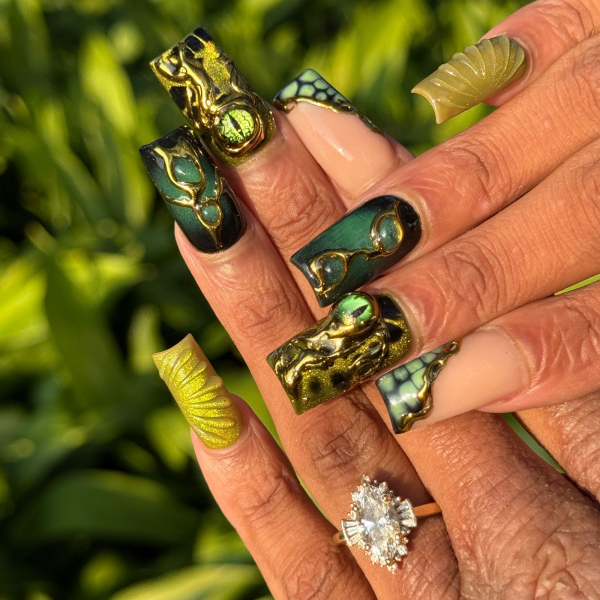
Corfah regularly travels to a nail salon in Baton Rouge that’s over an hour from her home in New Orleans. She says the time spent in the car is well worth it because her manicurist is sensitive to her needs.
Cynthea Corfah
At the end of the day, she urges other Black women with eczema not to dim their light because of their skin condition. “Keep showing up. Keep using your gifts. Keep taking up space,” says Corfah, who also works as a professional model and recently attended five casting calls for New York Fashion Week. “Don’t waste your time worrying about what other people think about your skin. Life is too short for that.”